Trustify: From a Course Project to a Hackathon Win
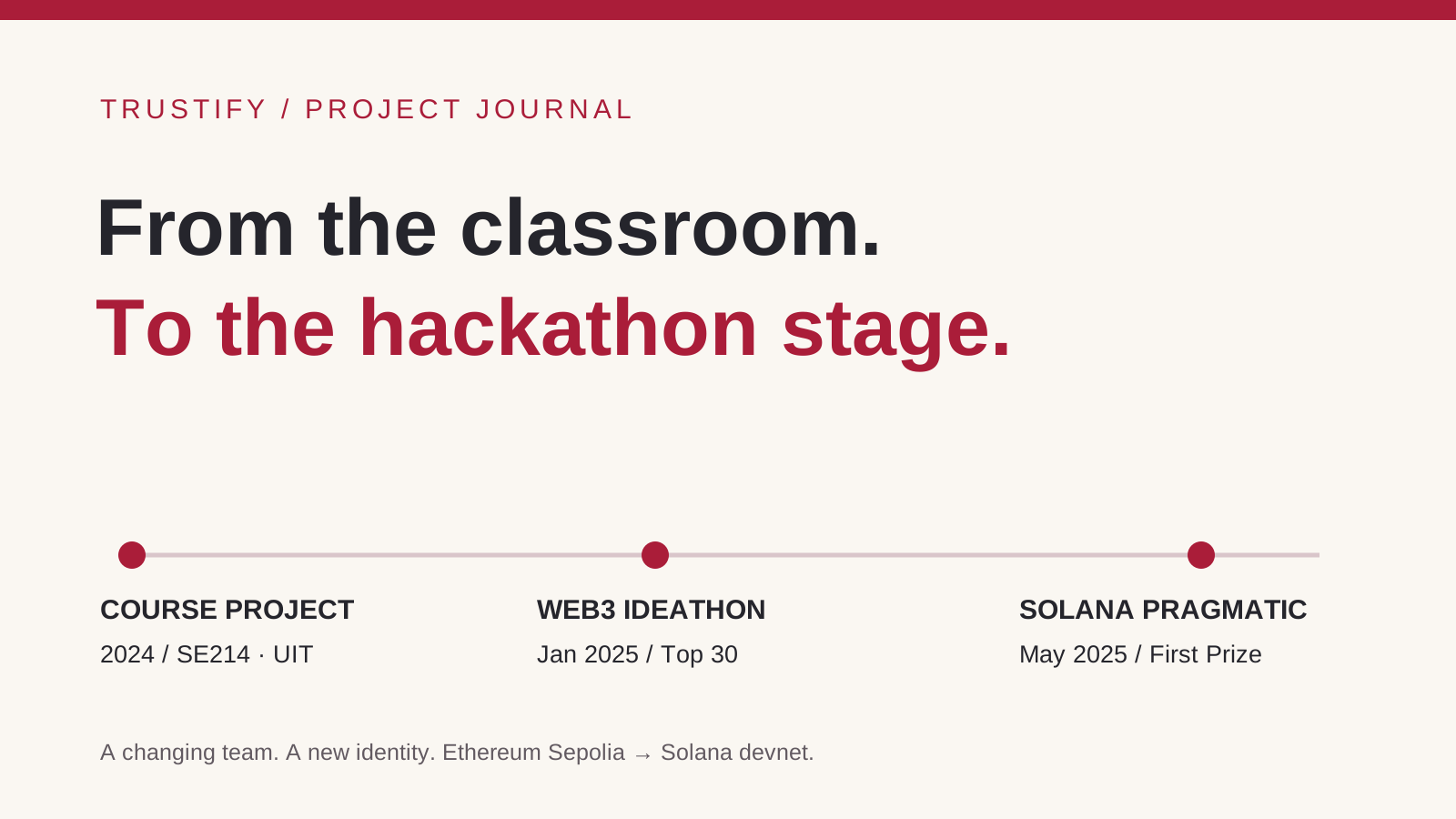
A changing team, a new identity, and a move from Ethereum Sepolia to Solana devnet.
Trustify started as my SE214 project at UIT. Back then, we called it CongChungOnline, which tells you pretty much everything about our naming process.
We were an 11-person team building a system for exchanging notarization documents online. By May 2025, I was working with four different teammates under the name NotLikeUs, our product was called Trustify, and we had moved its blockchain integration from Ethereum to Solana.
We won First Prize at IT Hackathon 2025 — Solana Pragmatic.
But there was a whole course project, an Ideathon, and a new team before that result.
The version we built for class
In September 2024, we started the project for Advanced Software Engineering — Công nghệ phần mềm chuyên sâu. The full Vietnamese topic was Phát triển hệ thống hỗ trợ trao đổi văn bản công chứng trực tuyến. We also used the English name Online Notarization Management System.
There was quite a lot to fit into that title. Someone needed to submit a hồ sơ công chứng. A notary needed to review it, request changes and manage the session. Documents, signatures, notifications and payments all had to connect to the same case.
My responsibilities covered business analysis, backend development, Scrum Master work, blockchain and DevOps. With eleven people, we split the work across requirements, design, web, mobile and testing. I spent time on both sides of the project: describing how the process should work and implementing parts of it.
We built the web application with React and the backend with Node.js, Express and MongoDB. For the blockchain integration, we used Ethereum Sepolia, ethers and Alchemy, with Pinata for IPFS integration.
That was the first version. It gave us a workflow and a codebase to build on after the subject ended.
Taking the idea beyond the subject
In January 2025, Trustify reached the Top 30 in the Web3 & AI Ideathon, part of the Web3 HackFest 2025 series.
This was our first competition milestone in this journey. We were taking something that began as coursework and presenting it as an idea that could continue outside the classroom. The notarization workflow was still at the centre of it, now with a product name: Trustify.
The Top 30 recognition came before the Solana hackathon. They were separate competitions, a few months apart, and both became part of the project’s story.
Eleven people, then a new team of five
The team I took to the May hackathon was different from the course team. I continued with four new teammates, and we entered as NotLikeUs.
Our five-person team covered engineering, product and project management, business analysis, business management and digital marketing. I took on PO, PM, software engineering and DevOps responsibilities.
We were carrying an existing idea into a new team. The original group had already put work into the requirements, interfaces, backend, mobile application and tests. That work remained part of Trustify’s foundation as we developed the hackathon version.
The product became Trustify; our team was NotLikeUs. We had a new lineup and another opportunity to keep working on it.
Moving the blockchain integration to Solana
For Solana Pragmatic, we moved from Ethereum Sepolia to Solana devnet and used Solana Web3.js and Metaplex for the NFT integration.
The surrounding application still had the same job. A user submitted documents, a notary worked through the case, and the resulting record needed to appear in the document wallet. Changing chains meant reconnecting that workflow to different transaction-signing and NFT tools.
This is the part of the project I find more useful to talk about than listing two blockchain names on a résumé. The integration reaches into the application: creating a certificate record, retrieving its metadata, showing its status and giving someone a way to look it up.
We were working on test networks throughout. The NFT was a technical part of the prototype, while the actual notarization process still depended on the notary and the documents being reviewed.
Bringing Trustify to the hackathon
On 24–25 May 2025, we brought Trustify to IT Hackathon 2025 — Solana Pragmatic at the VNUHCM Student Cultural House.
We won First Prize as NotLikeUs.
I’m proud of that result, and I also want to give the earlier stages their place in the story. Trustify had started months before: an eleven-person course team, requirements documents, a React application, a Node.js backend and an Ethereum integration. Then came the Ideathon recognition, the new team and the Solana version.
The award belongs to that longer journey. It also belongs to the team who brought that version of Trustify to the competition.
Coming back to it
I returned to Trustify in October 2026 to improve the interface and design system. Working on it again meant returning to the same practical questions: what should someone submit, where is their hồ sơ now, and what do they need to do next?
The demo you can try today includes that later redesign. It uses Solana devnet and simulated payments, so it is still a demonstration rather than a live notarization service.
I’m glad we continued the project after SE214. It gave me the chance to work with a new team, learn another blockchain ecosystem and bring an idea from class to two different competitions. Winning was a memorable part of it. So was getting to keep building something we had already spent a semester on.
I’ve also put together an updated pitch deck with a walkthrough of Trustify and downloadable PDF and PowerPoint versions.
You can find the original course repositories, our 2025 hackathon pitch, and the current frontend and backend on GitHub.
Thanks for reading
Got thoughts? I’d love to hear them.